Origin
In England, there was Father Christmas, who dressed in green and was an affable man who enjoyed good food and drink. In France, they speak of Père Noël—or Papá Noel, which means “Father Christmas.” In Germanic and Nordic countries, the god Wodan (Odin) leads the Yule hunt, the winter festival equivalent to Christmas.
The figure is based on the Greek Christian bishop named Nicholas, who lived in the 4th century in Anatolia, in the valleys of Lycia (in present-day Turkey). He was one of the most venerated people by Christians in the Middle Ages, and his relics are still preserved today in the Basilica of Saint Nicholas in Bari, Italy.
The most recent antecedent is Sinterklaas, a figure from Dutch folklore presumed to be based on Saint Nicholas. In fact, it is believed that the name Santa Claus is an English transliteration of Sinterklaas. Sometime in the 18th century, these traditions merged and gave rise to Santa Claus. His name first appeared in a New York gazette in the year 1773.
History of Nicholas of Bari
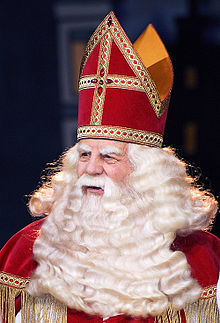
It is estimated that Nicholas of Bari was born around the year 280 in Myra, a city in the District of Lycia, in what is now Turkey.
He was the son of a wealthy family and grew up under the conflicting desires of his parents. His father wanted him to follow in his commercial footsteps in the Adriatic Sea, while his mother intended for him to be a priest like his uncle, the Bishop of Myra (an ancient Lycian city of the Aegean Anatolia, currently Turkey).
The plague resolved his dilemma by taking his parents while they were trying to help the sick of their city. Moved by the wretched situation of his people in the face of such a disease, the young man distributed his wealth among the needy and set out for Myra to live with his uncle and be ordained as a priest, which he achieved at the age of 19. Later, upon his uncle’s death, he was chosen to replace him as bishop.
Hundreds of stories are told of him, especially narrating his miracles and his kindness toward the poor. Such was the admiration that he became the patron saint of Greece, Turkey, Russia, and Lorraine (France).
Santa Claus and Christmas Gifts
In some countries, this character receives the name of Father Christmas, translated into their language (Father Christmas, Père Noël, Babbo Natale). In Spain and other Spanish-speaking countries, the French word Noël has been Hispanicized as Noel.
The custom of giving gifts to children has multiple precedents and regional variations. In ancient times, mid-December festivals were held in Rome in honor of Saturn (Cronus for the Greeks); at the end of these festivities, children received gifts from all the adults.
At a later time, when the myth of St. Nicholas had not yet taken physical form, other traditions existed, such as that of Italian children receiving gifts from a “fairy” called Befana.
In Catalonia and parts of Aragon, there is a “magical” log called Tió or Tió de Nadal (sometimes Cagatió, though the latter is more often the name used by those not native to the region, who lack deep knowledge of the culture and refer to the song used to make the Tió “defecate” or expel gifts: “Caga Tió, Tió de Nadal, no caguis arengades, que son salades, caga torrons, que son més bons!!!”).
Meanwhile, in the villages of some Basque and Navarrese valleys, the gifts were brought by the coalman Olentzero, and in the valleys of Biscay and surroundings, also by iratxoak (goblins) with green ermine hats.
In certain areas of central Galicia, one hears the legend of the Apalpador, who arrived on Christmas Day to feel the bellies of the children, leaving chestnuts for the thinner ones (to help them fatten up) and coal for the better-fed ones (to help warm their homes).
Over time, and with the known wonders of St. Nicholas, he gradually replaced many of these pagan characters.
The Transformation from St. Nicholas to Santa Claus and Father Christmas
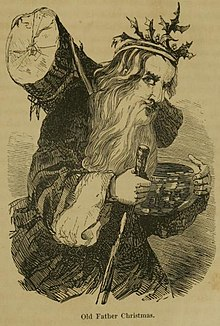 Old Father Christmas, illustration from an American book, 1855.
It is believed that the shift from the image of St. Nicholas to that of Santa Claus occurred around the year 1624. When Dutch immigrants founded the city of New Amsterdam, later named New York, they naturally brought their customs and myths with them, including that of Sinterklaas, the feast of their patron (celebrated in the Netherlands between December 5th and 6th).
In 1809, the writer Washington Irving wrote a satire, A History of New York, in which he distorted the Dutch saint, Sinterklaas, into the crude English-speaking pronunciation “Santa Claus.”
And in 1823, the Sentinel newspaper published the poem “A Visit from St. Nicholas,” subsequently attributed to Clement Clarke Moore, which finalized Santa’s popularity. Many of Santa’s current attributes come from Moore’s poem: the sleigh pulled by eight reindeer with their own names (Rudolph had not yet been included), the entrance through the chimney, the boisterous laugh, and the sack full of toys. However, the poem described him as a plump, agile elf who gives toys to children on Christmas Eve.
It was Thomas Nast, a 19th-century American cartoonist, who finished defining the current image of Santa Claus with a series of illustrations that appeared in Harper’s Weekly.
Subsequently, around 1863, he acquired the current fisonomy of the jolly, fat, bearded man for which he is most known. This was thanks to the German illustrator Thomas Nast, who designed this character for his Christmas strips in Harper’s Weekly. There he acquired his clothing; it is believed that his creator based the design on the robes of bishops from older times to create this “St. Nicholas,” who by then had nothing to do with Saint Nicholas of Myra.
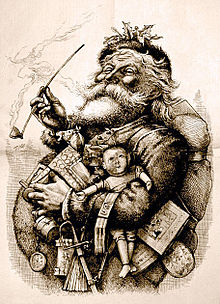 1881 illustration by Thomas Nast.
In the mid-19th century, the American Santa Claus crossed to England and from there to France, where he merged with Bonhomme Noël, the origin of Père Noël, who bore a physical resemblance to Santa Claus but dressed in white with gold trim. Similarly, at the end of the 19th century, following an American advertisement from the Lomen Company, the tradition was created that Father Christmas hailed from the North Pole, and reindeer became fully popularized as Santa’s means of transport.
- In 1902, in the children’s book The Life and Adventures of Santa Claus by L. Frank Baum, the story originated of how Claus earned immortality, as well as his title as a saint.
- In the 20th century, the Coca-Cola company commissioned the painter Haddon Sundblom to remodel the figure of Santa Claus to make him more human and believable. This version dates from 1931. At this point, however, it must be clarified that the belief that the red and white color of Santa Claus originated from Coca-Cola advertisements is only an urban legend, although they certainly contributed to the popularization of these colors and the myth itself. There are many earlier illustrations and descriptions, such as those by Thomas Nast (1869) or St. Nicholas Magazine (1926). Not to mention the ancient religious representations of Bishop St. Nicholas of Myra or St. Nicholas of Bari, where red and white religious vestments are common. While it is true that from the mid-1800s to the early 1900s there was no fixed color assigned to Santa—with green being one of the most common—the massive Coca-Cola campaign was a primary reason Santa Claus ended up perpetually dressed in red and white, though they were not the first to represent him thus.
The Home of Santa Claus
As for Santa’s dwelling, since the legend originated in the Northern Hemisphere, the idea spread in the early 20th century that he lived at the North Pole. However, one should remember that other nearby places are postulated as his home: Swedish Lapland, Finnish Lapland, and Greenland, since the North Pole is situated in the middle of the Arctic Ocean.
The Names of Santa Claus in Various Countries
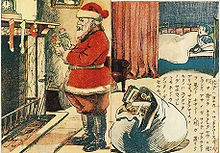 Japanese drawing of Santa Claus, 1914.
- Spanish-speaking countries (where gifts are traditionally brought primarily by “El Niño Jesús” or “The Three Wise Men”):
- Argentina, Paraguay, and Uruguay: Papá Noel.
- Bolivia, Colombia, and Ecuador: Papá Noel and sometimes Santa Claus.
- Chile: Viejito Pascuero.
- Costa Rica: Colacho (most popular), Santa Claus, and Santa.
- Cuba, Puerto Rico, and Dominican Republic: Santa Claus (often “Santa Clós” or simply “Santa”).
- El Salvador, Guatemala, and Nicaragua: Santa Claus or Santa.
- Spain: Papá Noel (with “Santa Claus” becoming more common due to US influence).
- Catalonia: Santa Claus and Pare Noel.
- Galicia: Papá Noel or Pai Nadal.
- Honduras: San Nicolás or Santa Claus.
- Mexico: Santa, Santa Claus, and Papá Noel.
- Panama: Santa Claus.
- Peru: Papá Noel, Santa, or Santa Claus.
- Venezuela: San Nicolás or Santa Claus.
- Albania: Babagjyshi Vitit të Ri.
- Germany: Nikolaus or Weihnachtsmann. Nikolaus represents the Christian tradition, while Santa Claus is seen as commercial.
- Brazil: Papai Noel.
- Denmark: Julemanden or Julenissen.
- United States: Santa Claus.
- Slovenia: Božiček.
- Estonia: Jõuluvana.
- Finland: Joulupukki.
- France: Père Noël.
- Wales: Siôn Corn.
- England: Father Christmas.
- Hungary: Télapó.
- Iran: Baba Noel.
- Iceland: Jólasveinn.
- Ireland: Daidí na Nollag.
- Italy: Babbo Natale.
- Latvia: Salatētis.
- Lithuania: Kalėdų senelis.
- Norway: Julenissen.
- Netherlands: Kerstman (Sinterklaas and Kerstman are separate characters).
- Poland: Święty Mikołaj.
- Portugal: Pai Natal.
- Romania: Moş Crăciun.
- Russia: Santa Claus or Ded Moroz (“Grandfather Frost”).
- Sweden: Jultomten.
Original Poem: “A Visit from St. Nicholas”
’Twas the night before Christmas, when all through the house
Not a creature was stirring, not even a mouse;
The stockings were hung by the chimney with care,
In hopes that St. Nicholas soon would be there;
The children were nestled all snug in their beds,
While visions of sugar-plums danced in their heads;
And mamma in her ’kerchief, and I in my cap,
Had just settled our brains for a long winter’s nap,
When out on the lawn there arose such a clatter,
I sprang from the bed to see what was the matter.
Away to the window I flew like a flash,
Tore open the shutters and threw up the sash.
The moon on the breast of the new-fallen snow
Gave the lustre of mid-day to objects below,
When, what to my wondering eyes should appear,
But a miniature sleigh, and eight tiny reindeer,
With a little old driver, so lively and quick,
I knew in a moment it must be St. Nick.
More rapid than eagles his couriers they came,
And he whistled, and shouted, and called them by name;
“Now, Dasher! now, Dancer! now, Prancer and Vixen!
On, Comet! on Cupid! on, Donder and Blitzen!
To the top of the porch! to the top of the wall!
Now dash away! dash away! dash away all!”
As dry leaves that before the wild hurricane fly,
When they meet with an obstacle, mount to the sky,
So up to the house-top the couriers they flew,
With the sleigh full of toys, and St. Nicholas too.
And then, in a twinkling, I heard on the roof
The prancing and pawing of each little hoof.
As I drew in my head, and was turning around,
Down the chimney St. Nicholas came with a bound.
He was dressed all in fur, from his head to his foot,
And his clothes were all tarnished with ashes and soot;
A bundle of toys he had flung on his back,
And he looked like a pedler just opening his pack.
His eyes—how they twinkled! his dimples how merry!
His cheeks were like roses, his nose like a cherry!
His droll little mouth was drawn up like a bow,
And the beard of his chin was as white as the snow;
The stump of a pipe he held tight in his teeth,
And the smoke it encircled his head like a wreath;
He had a broad face and a little round belly,
That shook, when he laughed, like a bowlful of jelly.
He was chubby and plump, a right jolly old elf,
And I laughed when I saw him, in spite of myself;
A wink of his eye and a twist of his head,
Soon gave me to know I had nothing to dread;
He spoke not a word, but went straight to his work,
And filled all the stockings; then turned with a jerk,
And laying his finger aside of his nose,
And giving a nod, up the chimney he rose;
He sprang to his sleigh, to his team gave a whistle,
And away they all flew like the down of a thistle.
But I heard him exclaim, ere he drove out of sight,
“Happy Christmas to all, and to all a good-night.”
English adaptation by Lola de la Cámara González.
I wish you a Merry Christmas and a Happy New Year!!!
Information extracted from various written, digital, and audiovisual media.