
“It’s not the years, honey, it’s the mileage.”
Conceived by American filmmaker George Lucas and produced by Lucasfilm, the series primarily recounts the experiences of the eponymous fictional adventurer as he locates objects of historical significance. The development of the franchise dates back to 1973 when Lucas wrote a story inspired by the movie serials of the 1930s and 1940s. It was not until 1977—after sharing the sketch with Steven Spielberg and just after the release of Star Wars—that an agreement was reached with Paramount Pictures to produce a series of films about Indiana Jones, who was to be played by actor Harrison Ford. The first film, Raiders of the Lost Ark, premiered in 1981 and, thanks to its commercial and critical success, gave rise to three more films shown in theaters between 1984 and 2008.
Protagonist: Harrison Ford
Harrison Ford was born on July 13, 1942, in Chicago (USA) into a middle-class family. After graduating from high school in 1960, he began studying English literature and philosophy and signed up for his first drama classes. Eventually, he abandoned his studies to dedicate himself entirely to his artistic career. In 1964, he moved to Hollywood with his first wife, attending various castings without much luck. Shortly after, he managed to sign a contract with a production company for small television appearances.
His big-screen debut took place in 1966 in James Coburn’s film Dead Heat on a Merry-Go-Round, in which he played a small role. After appearing in several films without much recognition, Ford signed with Universal Pictures, allowing him to intervene in numerous series such as The Virginian or Ironside. During that period, he met George Lucas and in 1972 worked for him in American Graffiti, which turned out to be a great success and allowed him to work a year later under Francis Ford Coppola in The Conversation. His big break came in 1977 when he landed the role of Han Solo in George Lucas’s blockbuster saga Star Wars.
In 1981, he was chosen to star in Steven Spielberg’s famous film Raiders of the Lost Ark, which would be followed by three sequels. This consecrated him as one of Hollywood’s most popular actors. Throughout his prolific career, he has starred in hundreds of titles such as Blade Runner (1982), Witness (1985)—for which he received his first Oscar nomination—The Fugitive (1993), The Devil’s Own (1997), and What Lies Beneath (2000).
Plot
The plot described in the main series of films recounts the experiences of Henry Walton Jones Jr., an archaeology professor better known by his nickname “Indiana Jones” or “Indy.” He often collaborates with the US government to locate objects of historical significance between the 1930s and 1950s.
In Indiana Jones and the Temple of Doom, after escaping from Chinese gangsters, the adventurer travels to India to recover mystical Sankara stones and rescue a group of children kidnapped by the Thuggee cult, whose members use black magic and carry out human sacrifices in honor of the goddess Kali.
Subsequently, Indy faces Nazis in the films Raiders of the Lost Ark and Indiana Jones and the Last Crusade to prevent them from seizing the Ark of the Covenant and the Holy Grail, which they intend to use to create an invincible army and obtain immortality, respectively. A couple of decades later, a similar situation occurs in Indiana Jones and the Kingdom of the Crystal Skull, when he learns that Soviet Union agents seek to obtain psychic powers from extraterrestrial crystal skulls.
Themes
Lucas and Spielberg conceived Raiders of the Lost Ark as an “homage to the action serials of the 1930s and 1940s that they watched as children”—an influence that also shaped Star Wars.
In the case of Indiana Jones, the intention is to represent an “old-school pulp fiction adventure: full of daring action, exotic foreign settings, death traps, and a creepy flavor of the supernatural.” Unlike other action films, Raiders is “a great example of how to keep a movie simple without losing its sense of humor, mystery, and a whole group of instantly memorable characters who not only drive the story but are interesting in their own right.” Generally, his finds involve “lost cities, treasures, and hieroglyphs.”
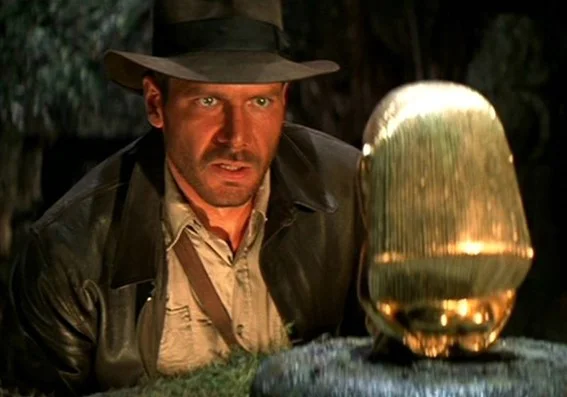
In each of his adventures, Jones must seek objects and relics of historical importance in exotic locations, such as a golden idol inside a temple in the middle of the jungle. He typically displays a “brave” personality, is an expert in arcane traditions, and is full of surprising tricks—like snatching a gun from an enemy’s hand. Sometimes even his best-laid plans go wrong, and he ends up running for his life in front of a ten-ton rock. Likewise, he is “a mercenary with an aura of heroism” whose “passion for the thrill of the hunt makes him love archaeology and, with it, his role in discovering the truth about ancient civilizations and history.”
Scene from the show “Indiana Jones Epic Stunt Spectacular!” at Disney’s Hollywood Studios.
Archaeology plays a significant role in Indy’s exploits, as the search for objects like the Ark of the Covenant involves the exploration, analysis, and interpretation of both the object and the site that houses it. It should be noted that most of the objects his adventures deal with are fictional—such as the Sankara stones and the Cross of Coronado—though there are certain disputes about the existence of the Grail and the Ark of the Covenant. According to Fred Hiebert: “The [Indiana Jones] films represent the ‘loot and scoot’ school of archaeology—not the way it’s actually done! The painstaking recording and documentation of every phase of an excavation tells us as much as the recovered object. However, what the films do is create that sense of wonder and mystery that arises when we try to discover the past.”
Other themes addressed by Indiana Jones include romance, the “danger and wonder” inherent in sequences like “an ancient relic protected by booby traps in the hero’s sights,” the fantasy of “powers beyond our reach,” the skepticism and cynicism exemplified in-the protagonist’s personality—resembling “old-school anti-heroes”—and religion. Even his main musical theme, the “Raiders March,” “instantly evokes images of Dr. Jones cracking his whip, boarding a Nazi submarine, or riding into the sunset with his father, Marcus, and Sallah” in a “triumphant” manner.
The Movies
Although Lucas always intended to produce a film trilogy about the character, the truth is he lacked ideas for the subsequent films in the series. Both he and Spielberg felt that the plot of Indiana Jones and the Temple of Doom should be “darker” than its predecessor, similar to The Empire Strikes Back in the original Star Wars trilogy. Likewise, Lucas preferred to set the plot a year before Raiders of the Lost Ark so that the Nazis would no longer be the antagonists. Influenced by their respective divorces occurring at that time, the filmmakers agreed that Indy’s second adventure should be related to a cult devoted to child exploitation, black magic, and human sacrifice. This led Lawrence Kasdan to refuse to repeat as a screenwriter, stating: “I thought it was horrible. There’s nothing satisfying about it. I think it represents a chaotic period in both their [Lucas and Spielberg’s] lives, and the film is very dark and vile.” Ultimately, the script was handled by Willard Huyck and Gloria Katz, while the film Gunga Din (1939) served as inspiration.
Like the second film, the script for Indiana Jones and the Last Crusade underwent several revisions before its final version. Some rejected ideas included Indiana facing a Scottish ghost, his resurrection at the hands of the Monkey King, and the search for a mask belonging to Montezuma in Mexico. Eventually, thanks to Menno Meyjes’s writing, the narrative axis became Jones’s relationship with his father: “an archaeological search for Indy’s own identity and for the acceptance of his father (which is more important than the Grail).” The film includes a prologue recounting an adventure from Indy’s youth as a Boy Scout, played by actor River Phoenix. The lack of ideas for a fourth film led Lucas to produce instead the television series The Young Indiana Jones Chronicles in the 1990s. From then on, he concluded that the archaeologist’s new adventure should include science fiction elements, especially aliens. However, both Spielberg and Ford initially rejected the concept, and Lucas preferred to focus on the Star Wars prequel trilogy. The script went through multiple changes and screenwriters before reaching its final version, and one of the discarded ideas included Jones being pursued by ex-Nazis. Production dragged on until the late 2000s, so Indiana Jones and the Kingdom of the Crystal Skull hit theaters in 2008, almost twenty years after The Last Crusade.
The possibility of a fifth film arose almost from the premiere of its predecessor; however, Disney’s acquisition of Lucasfilm in 2012 caused plans to be delayed indefinitely. Since then, Paramount retains distribution of the first three films, while Disney owns the distribution rights for any new Indiana Jones material. In early 2020, the production of a fifth film was announced, with a release scheduled for July 2022 (later moved), directed by James Mangold and again starring Harrison Ford.
Novels and Publications
There is a wide variety of novels inspired by the character, dating back to the novelization of Raiders of the Lost Ark by Campbell Black, published by Ballantine Books in April 1981. Following this line, the next three films also have their own novelizations by James Kahn, Rob MacGregor, and James Rollins, respectively. Children’s editions went on sale in 2008 by Scholastic.
Replica of the Ark of the Covenant reminiscent of the one in Raiders of the Lost Ark.
At Lucas’s request, MacGregor wrote six additional novels between 1991 and 1992 for Bantam Books, with plots consisting of prequels set in the 1920s and 1930s, specifically the stage following Indy’s college graduation. It should be added that their content is aimed at a young adult and adult audience and mostly features new characters. MacGregor’s series includes Indiana Jones and the Peril at Delphi, Indiana Jones and the Dance of the Giants, Indiana Jones and the Seven Veils, Indiana Jones and the Genesis Deluge, Indiana Jones and the Unicorn’s Legacy, and Indiana Jones and the Interior World. Bantam Books published six more novels about Indiana Jones’s exploits, the last in 2001: Indiana Jones and the Sky Pirates and Indiana Jones and the White Witch by Martin Caidin; as well as Indiana Jones and the Philosopher’s Stone, Indiana Jones and the Dinosaur Eggs, Indiana Jones and the Hollow Earth, and Indiana Jones and the Secret of the Sphinx by Max McCoy.
Additionally, German author Wolfgang Hohlbein wrote eight novels between 1990 and 1993: “Indiana Jones and…” The Feathered Snake, The Ship of the Gods, The Gold of El Dorado, The Sword of Genghis Khan, The Vanished People, The Secret of Easter Island, The Legacy of Avalon, and The Labyrinth of Horus. All these books are set in the 1940s, except The Feathered Snake, which takes place in 1929.
Other literary productions feature the Find Your Fate series by authors such as R. L. Stine, Rose Estes, Andy Helfer, and Ellen Weiss—with a theme similar to “Choose Your Own Adventure” publications—published by Ballantine Books between 1984 and 1987; plus Indiana Jones and the Army of the Dead (2009) by Steve Perry, among others.
Further publications include comic series primarily by Dark Horse Comics, whose first edition was an adaptation of the video game Indiana Jones and the Fate of Atlantis, a collaboration between William Messner-Loebs and Dan Barry released in 1992. Since then, other comics have been produced, such as Indiana Jones and the Iron Phoenix and Indiana Jones and the Spear of Destiny (1994–1995), written by Lee Marrs and Elaine Lee, respectively; plus adaptations of The Young Indiana Jones Chronicles and Indiana Jones and the Kingdom of the Crystal Skull. However, the first Indy comics date back to Marvel Comics titles created in the 1980s, consisting of versions of the first three films. Dark Horse reprinted these latter works between 2009 and 2010.
Film Saga
The first film: Raiders of the Lost Ark
Release Date: June 12, 1981
- Direction: Steven Spielberg.
- Screenwriter: Lawrence Kasdan.
- Photography: Douglas Slocombe.
- Story by: George Lucas and Philip Kaufman.
- Editor: Michael Kahn.
- Producer: Frank Marshall.
- Composer: John Williams.
Indiana Jones is an enigmatic character who gets involved in various requested jobs. It was the first time a hero appeared with a beard, dirty, sweaty, and afraid, yet facing his fears. He is a fragile hero. This aspect is achieved through various shots, from wide shots to close-ups of his face, showing feelings through gestures.
The dynamism of the first film is entirely hand-crafted. The special effects in the truck scene—where the villains approach Indy’s truck to sound evil—were created by mixing the sound of a lion’s roar with the truck’s engine. Harrison Ford used no stunt doubles; all the action scenes were filmed by him.
The second film: Indiana Jones and the Temple of Doom
Release Date: May 23, 1984
- Direction: Steven Spielberg.
- Screenwriter: Willard Huyck and Gloria Katz.
- Story by: George Lucas.
- Editor: Michael Kahn.
- Photography: Douglas Slocombe.
- Producer: Robert Watts.
- Composer: John Williams.
It is a much darker, bloodier, and more violent film. Drew Struzan is the creator of the iconic posters for all the films. The personal situations of Spielberg and George Lucas resulted in such a cruel and dark movie. John Williams took a theme from the 1950s and adapted it for the film’s musical scenes. Spielberg transports us to that era with continuous panning shots, forward and backward. He also gives a nod to James Bond when Indiana Jones appears wearing a white tuxedo. The plane they flee in is called OB-CPO in reference to Obi-Wan Kenobi and C-3PO from Star Wars. Upon closing the plane door, he removes the tailcoat and puts back on his Indiana Jones attire.
The third film: Indiana Jones and the Last Crusade
Release Date: May 24, 1989
- Direction: Steven Spielberg.
- Screenwriter: Jeffrey Boam.
- Story by: George Lucas and Menno Meyjes.
- Photography: Douglas Slocombe.
- Editor: Michael Kahn.
- Producer: Robert Watts.
- Composer: John Williams.
Sean Connery (James Bond) plays the role of Indy’s father. This was a peak moment for this prolific actor, who was working on several significant films like The Name of the Rose, The Untouchables, and Highlander. In the first scene, we get an explanation for his use of the whip, the hat, and the origin of his name from his dog, Indiana. Another mythical scene is when his father is working; Indiana enters the office to tell him something important, and the father continues his tasks with his back to his son. Without looking at him, he tells him to take a breath and count to twenty in Greek; Indiana leaves and closes the door.
Indiana Jones’s nature is not philanthropic; he inherits the hat (Fedora) from a “bad guy,” a rogue. This film is the closest to the comedy genre. For example, the fireplace scene, where a reverse shot shows that father and son have had relations with the same woman.
The fourth film: Indiana Jones and the Kingdom of the Crystal Skull
Release Date: May 22, 2008
- Direction: Steven Spielberg.
- Screenwriter: David Koepp.
- Story by: George Lucas and Jeff Nathanson.
- Photography: Janusz Kaminski.
- Editor: Michael Kahn.
- Producer: Frank Marshall.
- Composer: John Williams.
A mythical scene in this film is when he has to hide in a refrigerator during a nuclear test explosion in a typical American town built for that purpose. The exterior of Area 51 appears, clearly showing it was shot in a studio, whereas the previous ones were filmed on location. This latest film received disastrous reviews; the hero is left finished, crushed, and broken. They include a son who pays homage to the film Mad Max (Mutt). Some viewers and critics did not see the mythical character of Indiana Jones—there is no hero, the mythical essence of the previous films is missing. Hence the debate among many film experts about whether it should be included in the saga.
The fifth Indiana Jones film
Release Date: June 30, 2023 (originally July 2022)
- Direction: James Mangold.
- Screenwriters and Story by: Mangold, Jez Butterworth, and John-Henry Butterworth.
- Photography: Phedon Papamichael.
- Producers: Marshall, Kathleen Kennedy, Simon Emanuel, and Spielberg.
- Composer: John Williams.
The fifth installment adds Antonio Banderas to the cast. He joined the saga in a role that was initially unknown. Harrison Ford’s character remains married to Marion Ravenwood, though Karen Allen’s return was a surprise after Kingdom of the Crystal Skull. We also know the Nazis return as Indiana’s classic enemies, and the story involves a race against time and a mysterious dial.
Did you enjoy these curiosities? Discover more articles and stories in my collection.
Related Articles
Literary Curiosities | The Mystery of First Editions | My Stories | The Last Letter | Inspector Rafael | The Case of the Closed Room
Categories
Subscribe
Receive new articles and stories directly in your email. __Subscribe