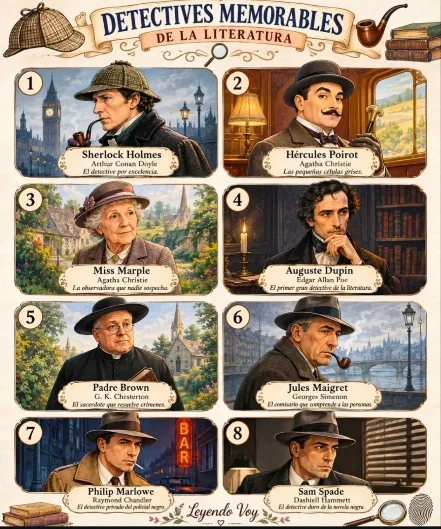
I must confess that when I was little, the first thing that brought me closer to the Holmesian world was the Sherlock Holmes cartoon series where the characters were dogs; I loved everything about that wonderful series. As I grew older, I began to watch the first Sherlock Holmes films in black and white, which in my opinion make you immerse yourself more in the era; however, Watson appears as a mere fool and companion to Sherlock. At sixteen, I was given the complete Sherlock Holmes saga, and I devoured the books; I fell in love with the main character. Currently, I watch every series and film based on Sherlock, although to be honest, most leave much to be desired and are not faithful to the books at all.

With this brief introduction, I will try to explain the pastiches and homages to Sherlock Holmes that have been made without taking into account Arthur Conan Doyle’s opinion or without being faithful to the books.
The RAE (Royal Spanish Academy) defines pastiche as “imitation or plagiarism consisting of taking certain characteristic elements of an artist’s work and combining them in such a way as to give the impression of being an independent creation.” According to several researchers specializing in the detective, there are currently more than 20,000 Holmes pastiches—if we count parodies, imitations, and works made with affection and admiration based on the detective character.
Success came to Doyle with the publication of the detective’s stories in The Strand Magazine in 1891: A Scandal in Bohemia, The Red-Headed League, A Case of Identity… “Sherlockmania” had emerged and, almost at the same time, the first pastiches arrived.
The first pastiche was written by J.M. Barrie in 1891; it was titled “An Evening with Sherlock Holmes,” in which he poked fun at the detective’s deductive abilities.
As a curious fact, the detective’s stories were translated in China in 1896, where Holmes was christened Fu-erh-mo-hsi. When the original material ran out, new stories continued to appear in which the character faced supernatural threats such as ghosts or fox-women.
Germany was not left behind either; 230 issues of the serial titled The Detective Sherlock Holmes and His World-Famous Adventures from 1907 to 1911 were published. When Doyle’s representative sued the publisher for using Holmes without permission, the ruling forced them to change the title to From the Secret Archives of the World’s Best Detective. This was modified from the twelfth issue onward, although the ruling did authorize the use of the detective within the stories themselves.
 Poster in Germany. (William Gillette asked Arthur Conan Doyle for permission to perform an adaptation of the play and script it).
In 1944, the anthology The Misadventures of Sherlock Holmes, edited by Ellery Queen, was published. It gathered talents of the stature of Agatha Christie, Mark Twain, and legendary Sherlockians such as Vincent Starrett or Anthony Boucher, with a selection of the most notable parodies and pastiches appearing over the 50 years following the detective’s creation.
The 1970s saw a Sherlockian boom, initiated by the successful novel The Seven-Per-Cent Solution (1974) by Nicholas Meyer, which was made into a film in 1976. In this case, Holmes travels to Vienna to be detoxified of his cocaine addiction by Sigmund Freud, and both become entangled in a criminal plot. Meyer wrote several more pastiches of varying quality.
The reality is that the author Conan Doyle introduced Sherlock Holmes’s cocaine addiction for the first time in 1887 in A Study in Scarlet. In this book, Dr. Watson notes: “on these occasions, I have noticed such a dreamy, vacant expression in his eyes, that I might have suspected him of being addicted to the use of some narcotic.” Sherlock’s cocaine addiction was mentioned again in The Sign of the Four when he injects himself with a seven-per-cent solution of cocaine. As Dr. Watson watches Sherlock do this, he says: “it is cocaine, a seven-per-cent solution. Would you like to try it?” In later Sherlock Holmes stories, Watson continues to observe the detective’s cocaine habit and even mentions that the occasional use of this drug helped him reason through his cases.

From the same era, many other films stand out, such as the very entertaining Sherlock Holmes vs. Dracula (1978) by Loren D. Estleman, which opened the season for encounters between the detective and the King of Vampires.

Exit Sherlock Holmes (1977) by Robert Lee Hall takes the action into the realm of science fiction!
In this field, it is essential to mention the anthology The Science-Fictional Sherlock Holmes (1960), which includes stories by giants of the genre such as Poul Anderson or the aforementioned Anthony Boucher.

The culmination of this great period would be the film Murder by Decree (1979), one of the best depictions of the confrontation between Holmes and Jack the Ripper.

And the last one, in my opinion, is the book by Arturo Pérez-Reverte titled The Final Problem (El problema final); you will have to read it to know what I am talking about.
“You know my method. It is based upon the observation of trifles.” — Sherlock Holmes.
Note: The information has been extracted from different audiovisual media.