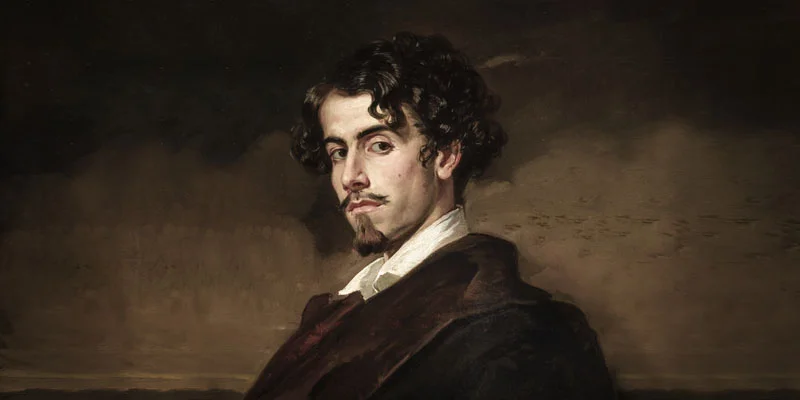
Gustavo Adolfo Domínguez Bastida; Seville, 1836 - Madrid, 1870. Spanish poet. Along with Rosalía de Castro, he is the maximum representative of post-Romantic poetry—a trend whose distinctive traits were intimate themes and an apparent expressive simplicity, far removed from the rhetorical vehemence of traditional Romanticism.
The Invisible Atoms of the Air
The invisible atoms of the air
throb and ignite around;
the sky dissolves in rays of gold;
the earth shudders with joy;
floating on waves of harmony, I hear
the murmur of kisses and the beating of wings;
my eyelids close… What is happening?
It is love, passing by!
Influence on Other Authors
Bécquer’s work exerted a strong influence on later figures such as Rubén Darío, Antonio Machado, Juan Ramón Jiménez, and the poets of the Generation of ’27. Critics judge him to be the initiator of contemporary Spanish poetry. Bécquer is, above all, a living poet—popular in every sense of the word—whose verses, with their moved voice and winged beauty, have enjoyed and continue to enjoy the preference of millions of readers.
Childhood
His direct ancestors, starting with his own father, José Domínguez Bécquer, were painters of Andalusian customs, and both Gustavo Adolfo and his brother Valeriano were highly gifted at drawing. Valeriano, in fact, leaned toward painting. However, their father died on January 26, 1841, when the poet was four years old, and that pictorial vocation lost its primary support. In 1846, at age ten, Gustavo Adolfo entered the Royal College of Humanities of San Telmo in Seville, where he received lessons from a disciple of the great poet Alberto Lista, Francisco Rodríguez Zapata. There he met his great friend and companion in literary endeavors, Narciso Campillo, also an orphan. Campillo taught him to swim in the Guadalquivir and to handle a sword. Even at such an early age, both began writing together for the first time.
On February 27, 1847, the Bécquer brothers became orphans of their mother as well. They were then adopted by their maternal aunt, María Bastida, and Juan de Vargas, who took charge of his seven nephews. From then on, Valeriano and Gustavo (who was ten years old) “adopted” each other; they spent their adolescence in Seville, studying humanities and painting. Throughout their lives, they would undertake many projects and journeys together.
When the College of San Telmo was suppressed by Isabella II in 1847 (becoming the palace of the Dukes of Montpensier in 1849), Gustavo Adolfo was left disoriented. He then went to live with his godmother, Manuela Monnehay Moreno, a young woman of French origin and a well-off merchant whose means and literary sensitivity allowed her to have a modest but select poetic library. In this library, Gustavo Adolfo began his fondness for reading.
Bécquer the Writer
In 1854, he moved to Madrid with the intention of pursuing a literary career. However, success did not smile upon him; his ambitious project to write a History of the Temples of Spain was a failure, and he only managed to publish one volume years later.
To survive, the poet wrote in collaboration with his friends (Julio Nombela and Luis García Luna, and in 1856 he was also joined by his friend Ramón Rodríguez Correa; Campillo had fallen ill and returned to Seville). Under the pseudonym Gustavo García, they wrote comedies and zarzuela librettos such as La novia y el pantalón (The Bride and the Trousers, 1856), in which he satirizes the bourgeois and anti-artistic environment surrounding him, and La venta encantada (The Enchanted Inn), based on Don Quixote. He also supported himself through translations from French and small jobs as an editorial assistant, scribe, and illustrator. That year, he went with his brother to Toledo—a place of love and pilgrimage for him—to gain inspiration for his future book History of the Temples of Spain. At the time, he was interested in Byron’s Hebrew Melodies and Heine’s Intermezzo through the translation that Eulogio Florentino Sanz performed in 1857 in the magazine El Museo Universal.
It was precisely in that year, 1857, when the tuberculosis appeared that would eventually send him to the grave—though this last point is not entirely clear.
During a stay in Seville in 1858, he spent nine months in bed due to an illness; it was likely tuberculosis, though some biographers lean toward syphilis. During his convalescence, while being cared for by his brother Valeriano, he published his first legend, El caudillo de las manos rojas (The Chieftain of the Red Hands). It was at this time that he met Julia Espín, whom some critics believe was the muse for several of his Rimas (Rhymes). However, for a long time, it was erroneously believed to be Elisa Guillén, with whom the poet was said to have had a relationship until she abandoned him in 1860, and who was thought to have inspired his most bitter compositions.
In 1860, he published Cartas literarias a una mujer (Literary Letters to a Woman), in which he explains the essence of his Rimas, which allude to the ineffable.
In 1861, at the home of the doctor treating him for a venereal disease, Francisco Esteban, he met the woman who would become his wife, Casta Esteban y Navarro. They married in the church of San Sebastián in Madrid on May 19, 1861, and had three children together.
The marriage was never happy, and the poet took refuge in his work or in the company of his brother Valeriano during the latter’s trips to Toledo to paint.
The most fruitful stage of his career was from 1861 to 1865, years in which he composed most of his Leyendas (Legends), wrote newspaper chronicles, and drafted the Literary Letters to a Woman, where he explains his theories on poetry and love.
In 1862, his first son, Gregorio Gustavo Adolfo, was born in Noviercas (Soria), where Casta’s family owned property and where Bécquer had a small house for his rest and recreation. There he began to write more to support his small family, and several of his works was the result of this intense work.
But in 1863, he suffered a serious relapse in his illness. To recover, Bécquer moved with his brother to live at the Monastery of Veruela (Zaragoza), situated on the slopes of Moncayo, whose pure air was known as a treatment for tuberculosis. This ancient exclaustrated Cistercian monastery possessed great Romantic charm and was a place of inspiration for both brothers. Gustavo Adolfo wrote there the letters later grouped as Desde mi celda (From My Cell), a set of beautiful landscape descriptions. Many of his legends are also set in Moncayo. Despite the brief stay (less than a year), this stage constitutes a fundamental part of the Bécquer brothers’ artistic production.
After his recovery, both left for Seville with their family. From that time is the portrait painted by his brother, which is preserved in the Museum of Fine Arts in Seville. Bécquer admired and idolized his brother and almost always worked with him, but his brother’s relationship with Casta was not good, as she could not stand his character and his constant presence in the house.
González Bravo, Gustavo’s friend and patron, appointed him censor of novels in 1864, and the writer returned to Madrid. Economically, things improved for the poet from 1866 onward, allowing him to leave his newspaper chronicles and concentrate on his Leyendas and his Rimas, published in part in the weekly El Museo Universal, where he worked until 1867 with a salary of twenty-four thousand reales. That same year, his second son, Jorge Bécquer, was born.
But with the revolution of 1868, the poet lost his job, and his wife abandoned him that same year for another man; she was tired of the writer’s bohemian life.
However, the spouses still wrote to each other. His book of poems disappeared in the revolutionary disturbances, and to flee from them, he went to Toledo with his brother Valeriano, where he remained for a short time. It was there that he finished reconstructing the manuscript of the Rimas, the original of which had disappeared when his house was sacked during the September revolution.
In December, his third son, Emilio Eusebio, was born in Noviercas, fueling his marital tragedy, as it was said that this last child belonged to Casta’s lover.
In 1870, he and his brother left for Madrid to lead La Ilustración de Madrid, which Eduardo Gasset had just founded with the intention of having Gustavo Adolfo direct it and Valeriano work on it as an illustrator. In September, the death of his inseparable brother and collaborator plunged him into deep sadness. In November, he was named director of a new publication, El Entreacto, in which he hardly managed to publish the first part of an unfinished story.
Possibly due to a winter chill in the first half of December, his already precarious health worsened, and he died on the 22nd of that month, coinciding with a total solar eclipse. The cause of his death remains unclear, with possibilities including tuberculosis, syphilis, or liver problems. In the days of his agony, he asked his friend, the poet Augusto Ferrán, to burn his letters (“they would be my disgrace”) and to publish his work (“If possible, publish my verses. I have a premonition that dead I will be better and more widely known than alive”). He also asked that they take care of his children. His last words were “All mortal.”
Bécquer as an Illustrator
One of his drawings from the series Les morts pour rire: Bizarreries.
From childhood, he was surrounded by his father’s canvases and drawings, which also made him interested in painting. He said that painting is a means of expression for the ineffable, surpassing writing.
Among his friends, his talent as a draftsman was always appreciated, and he collaborated several times with his brother Valeriano. His great technique stands out and reflects his inner world. Life and death are intertwined in most of his drawings from his series Les morts pour rire: Bizarreries. The drawn scenes provoke laughter—laughing at death.
He also made drawings representing his imaginary worlds reflected in his Rimas and Leyendas. Julia Espín also encompasses a large part of Bécquer’s pictorial work, shown in various situations.
Bécquer and Music
Bécquer was always a great fan of musical theater. He worked on five zarzuelas in collaboration with his friend Luis García de Luna, of which only one remains, La venta encantada. 19th-century composers like Gabriel Rodríguez Benedicto and Tomás Bretón set some of his Rimas to music. Also, in the 20th century, the composer Manuel de Falla composed Dos rimas de Bécquer (Two Rhymes by Bécquer, 1900) for soprano and piano. And these are just a few, among whom we should also mention Joaquín Turina, Enrique Granados, Isaac Albéniz, Jesús Guridi, Federico Mompou, and Antón García Abril…
Works
- Rimas: A work collected by his friends after the fire at the house where these poetic works were kept. It serves as a sort of love story where the poet moves through the creative process, hopeful love, disillusionment, and pain or death.
- Historia de los templos de España: Madrid, 1857 (only Volume I published).
- Cartas literarias a una mujer: 1860-1861, published in El Contemporáneo.
- Cartas desde mi celda: Madrid, 1864. Nine letters published in El Contemporáneo and later gathered under the title Desde mi celda (From My Cell).
- Libro de los gorriones: 1868, manuscript.
- Obras completas: Madrid, Fortanet, 1871, two volumes.
Legends (Leyendas)
- El caudillo de las manos rojas, 1859.
- La vuelta del combate, 1858.
- La cruz del diablo, 1860.
- La ajorca de oro, 1861.
- El monte de las ánimas, 1861.
- Los ojos verdes, 1861.
- Maese Pérez, el organista, 1861.
- Creed en Dios, 1862.
- El rayo de luna, 1862.
- El Miserere, 1862.
- Tres fechas, 1862.
- El Cristo de la calavera, 1862.
- El gnomo, 1863.
- La cueva de la mora, 1863.
- La promesa, 1863.
- La corza blanca, 1863.
- El beso, 1863.
- La Rosa de Pasión, 1864.
- La creación, 1861.
- ¡Es raro!, 1861.
- El aderezo de las esmeraldas, 1862.
- La venta de los gatos, 1862.
- Apólogo, 1863.
- Un boceto del natural, 1864.
- Un lance pesado, 1864.
- Memorias de un pavo, 1865.
- Las hojas secas, 1865.
- Historia de una mariposa y una araña.
- La mujer de piedra (unfinished).
- Amores prohibidos.
- El rey Alberto.
Theater
- La novia y el pantalón.
- La venta encantada.
- Las distracciones.
- La cruz del valle.
- Tal para cual.
Articles
- El maestro Herold
- La soledad
- El Carnaval
- La Nena
- Las perlas
- La mujer a la moda
- La pereza
- La ridiculez
- Caso de ablativo
- El grillito cantor
Other Works
- El talismán: Zarzuela with music by Joaquín Espín y Guillén and libretto by Bécquer, based on Victor Hugo’s Notre-Dame de Paris. The work was never premiered and was thought lost until its discovery in 2014.
- Los Borbones en pelota: An album signed with the pseudonym SEM, for which Gustavo Adolfo was allegedly responsible along with his brother Valeriano, though some researchers reject their authorship in favor of Francisco Ortego.