Since the dawn of time, myths have existed in the collective subconscious. From there, the concept of vampirism was born, appearing in different cultures and countries under various names.
This myth persists through various branches: literary, mythological, zoological, religious, psychological, “energetic” illnesses, and more. We can find different types of vampirism, which is why the concept always endures.
The “rules” of the myth were shaped over time, particularly in Central Europe. The plague was partly to blame; the need to bury bodies quickly often led to hasty burials without ensuring the person had truly deceased, especially in the Carpathian region. When there was suspicion that someone might rise from the grave (those born on Holy Saturday or individuals with intellectual disabilities were often suspects), the practice was to bury them face down.
In a city in Czechoslovakia a few years ago, several skeletons were found buried face down; three of them were facing North, with nails driven into their legs and hips, heavy slabs placed over the bones, and their severed heads between their legs. Garlic cloves or their flowers were placed in the orifices to prevent evil from escaping.
Starting with Romanticism, the role of the vampire found a more romantic, attractive, and sensual aura through literature.
In the Austro-Hungarian Empire, Empress Maria Theresa I even sent her personal physician to verify reports of vampirism and the widespread fear among the population. Two years of investigation were necessary to rule that it was all false. The figure of Van Helsing was inspired by this physician, as he applied science to determine the reality of vampirism.
In the mid-19th century, with the Age of Reason, these myths became alluring. Lord Byron himself (the British Romantic poet), an attractive boxer of great culture, inspired the romanticized vampire.
Background of Dracula
- The Vampyre, by Polidori (1816): A precursor to Bram Stoker’s Dracula. It created the archetype of the romantic vampire, based on Polidori’s travels with Lord Byron while working as his doctor. This novella arose from a bet between Byron, Mary Shelley, and “poor Polidori,” as Mary and Byron used to call him.
- Carmilla, by Sheridan Le Fanu (1872): Laura, a young woman living a placid life, finds it turned upside down and terrifying when she meets Carmilla. Their meeting occurs after Carmilla’s carriage crashes in front of the castle gates, and her mother leaves her there until she can be collected. This guest is… strange, rarely leaving her room.
- Dracula, by Bram Stoker (1897): It took Stoker seven years to write. The story is told in an epistolary format. It wasn’t until 1983 that it became part of the Oxford University classics.
This type of epistolary literature, consisting of letters and diary entries, was not common at the time.
It begins with the protagonist Jonathan Harker writing letters about his journey to Dracula’s castle. At a certain point, he stops writing, leading the reader to believe he has died. Later, voices are given to his fiancée Mina, to her friend Lucy, to a local newspaper reporter, and to Doctor Van Helsing through a dictaphone.
The author wrote other novels, but none ever achieved the same success as Dracula.
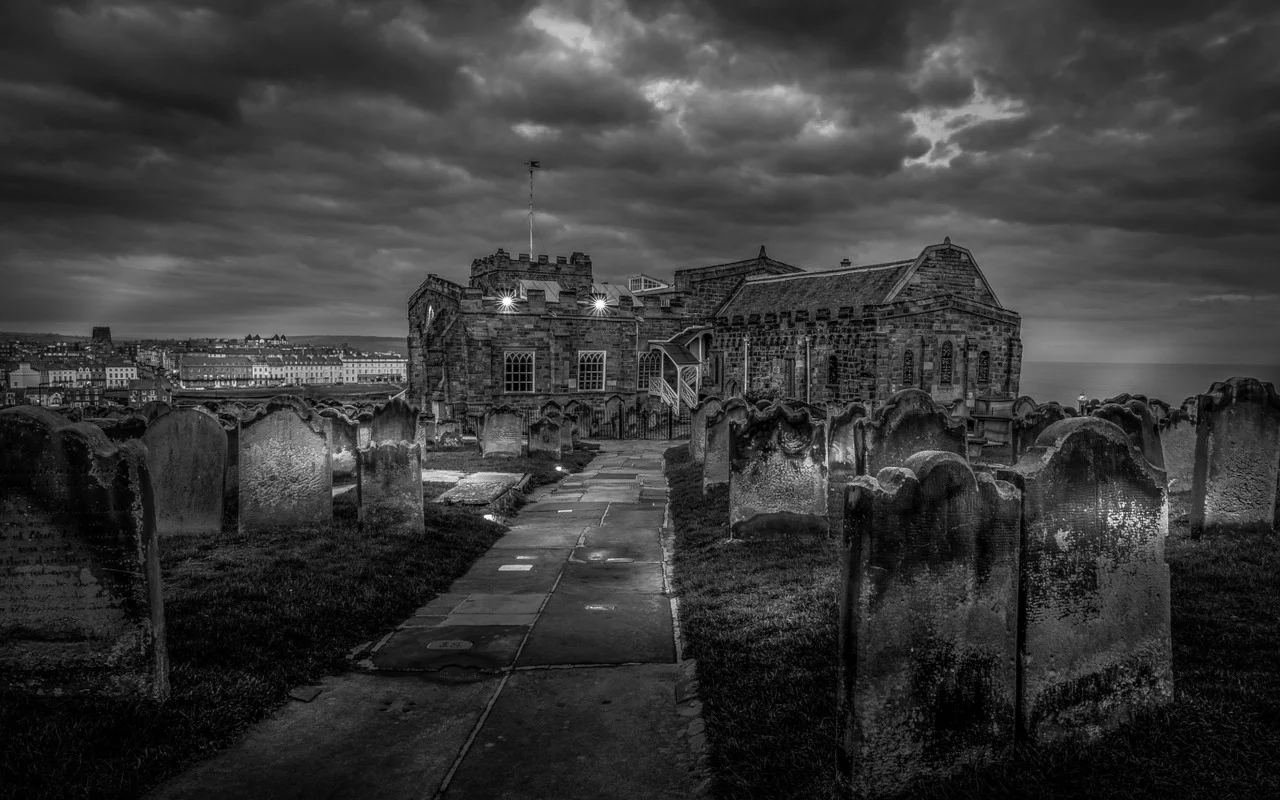
In 1890, Stoker began his research, consulting 28 books; the history of the Balakos princes caught his attention. He also noted an incident in the port of Whitby where a ship arrived laden with sandbags and a large black dog, which jumped ship and ran to the cemetery. He wanted to include this in the book, but his editor forced him to cut 100 pages from the manuscript.
Key Characters
- Count Dracula
- Jonathan Harker
- Mina Murray
- Lucy Westenra
- John Seward
- Renfield
- Van Helsing
- Quincey Morris
- Arthur Holmwood
Author’s Sources
- Prince Vlad III (The Impaler), Vlad Dracul or Vlad the Dragon: A 15th-century Prince of Wallachia who fought against the Ottomans and Hungarians to protect Christianity in his territory, though he was noted for his sociopathic tendencies. The book suggests it was based on this historical figure, though mostly for the name “Dracula.”
- Elizabeth Báthory (The Blood Countess), 1560-1614: This is a fundamental source for the myth. When she began to lose her youth, an incident occurred where she struck a maid and blood fell on her hand; she began to believe her skin regenerated with blood. Because of this, she ordered the killing of every young virgin in the region for ten years, bathing in their blood. This is when vampirism began to be associated with nobility.
- Another source is an Irish chieftain from the 5th century. He was enormously cruel and hated by all tribes. They eventually killed him and buried him standing up according to their customs, but he returned to life. The only way to finish him forever was with a yew wood sword through the heart.
- Essential phrase: The coachman’s line when transporting Jonathan to Count Dracula’s castle: “The dead travel fast,” is based on an old German epic poem about Lenore, another source. In an old Austrian village, there was a woman named Lenore who spent all her wealth to cure her many ailments. She was accused of vampirism, and her body was autopsied to perform an anti-vampiric ceremony.
Rules of Dracula
In Chapter XVIII of the book, certain rules applicable to Dracula appear. For example, he can change shape at certain hours, he tolerates sunlight but not if it’s direct, and he can turn into mist, a dog, or sheep.
Description of Dracula
He is described as an old, unpleasant being with a strong odor.
The fangs are a 19th-century invention; prior to Dracula, vampires were depicted as feeding by tearing at the throat. They were likely modified to be less repulsive, leading to the idea of retractable fangs, which created a clear sexual allegory.
Film Adaptations of Dracula
- Nosferatu: An apocryphal adaptation created to avoid paying royalties to Stoker’s heirs. Set in a small German town, its special effects were extraordinary for the time, featuring spectacular shadow play and occultist undertones. The character’s mouth is full of fangs.
- Dracula (1931, Tod Browning): This version did not adapt Stoker’s book directly but rather a 1927 stage play.
- Horror of Dracula (1958): Starring Christopher Lee as Dracula and Peter Cushing as Van Helsing. In the novel, Van Helsing (an elderly Dutch doctor with multiple degrees in medicine, philosophy, literature, and law) is of great importance. However, in film, he only truly regained that stature in the 1958 version—the first in color. The staging of certain scenes is exceptional, such as crossing two candelabras to form a cross.
- Bram Stoker’s Dracula (1992): Directed by Francis Ford Coppola with a budget of 40 million dollars. It plays heavily with light and shadow. Many scenes were filmed but cut due to excessive violence.