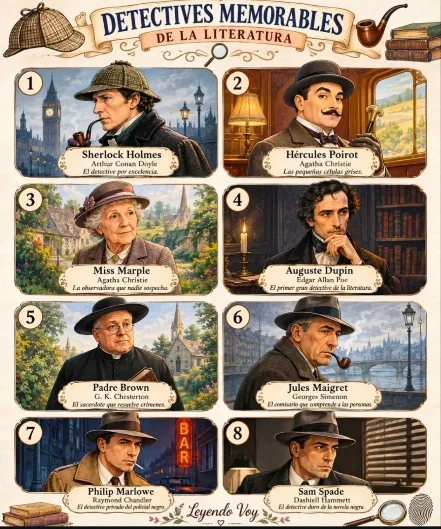
Arthur Conan Doyle.
Arthur Conan Doyle was born in 1859 into a Catholic Irish family, the second of ten siblings. His mother was a great reader and storyteller, while his father belonged to a lineage of successful painters but suffered from alcoholism, which led to bouts of violence. The family moved countless times because of this struggle.
At his mother’s request, his maternal uncles—who belonged to a wealthy social class—sent him to a Jesuit preparatory school in Stonyhurst, England, at the age of nine to keep him out of harm’s way. He remained there until sixteen, followed by two more years at another school. By the time he left, he had become entirely agnostic, though he would eventually move beyond even that belief.
He studied medicine at the University of Edinburgh from 1876 to 1881. There, he played cricket on a team alongside future famous writers such as J.M. Barrie, the creator of Peter Pan, and Robert Louis Stevenson, the man responsible for Treasure Island. It was also there that he met the man who, with his deductive skills, would inspire Sherlock Holmes: Dr. Joseph Bell. Bell used deduction on his patients, and though Doyle respected his mind, the relationship was complex. During this period, Doyle also wrote his first short story, which was rejected by Blackwood’s Magazine. His first published story was The Mystery of Sasassa Valley, a tale set in South Africa, published in Chambers’s Edinburgh Journal in 1879.
In 1885, he completed his doctorate, and in 1890, he studied ophthalmology before settling in London.
He participated in two wars and two parliamentary elections, and he spoke out against colonial racism. He was even asked for help to prove the innocence in a doubtful prosecution; by applying the latest detective techniques—much like his character Sherlock—he managed to demonstrate the prisoner’s innocence.
He was a great sportsman and a pioneer of alpine skiing and motoring.
He married Louise Hawkins (1857-1906), better known as “Touie,” with whom he had two children: Mary Louise and Arthur Alleyne. During the First World War, he became deeply involved in spiritualist circles, a shift likely sparked by the loss of his eldest son in the conflict. He began to believe in the world of fairies and gave lectures worldwide. During this journey, he lost the friendship of the great Houdini when, in one of their spiritualist meetings, he claimed to invoke the magician’s deceased mother.
His platonic love: upon settling in Surrey, he met Jean Leckie, a woman with whom he fell instantly in love. Young, cultured, attractive, single, a consummate rider, and gifted with a mezzo-soprano voice. However, he remained married to his wife because she was ill. He maintained an emotional bond that remained a secret for a decade. In 1906, Touie passed away, and a year later, he married Leckie in a large wedding. The couple moved to Sussex, where they lived with his two children from his previous marriage and the three they had together.
In 1902, he was knighted by the Crown, partly due to his extensive chronicle of the conflict, The Great Boer War.
He died on July 7, 1930, at the age of 71, from a heart attack in Crowborough, England. A statue of him stands in that town, where he resided for 23 years.
His Works.
- A Study in Scarlet (1887)
- The Sign of the Four (1890)
- Adventures of Sherlock Holmes (1891–92)
- The Memoirs of Sherlock Holmes (1892–93)
- The Hound of the Baskervilles (1901–02)
- The Return of Sherlock Holmes (1903–04)
- The Valley of Fear (1914–15)
- His Last Bow (1908–17)
- The Case-Book of Sherlock Holmes (1924–26)
- The Lost World (1912)
- The Poison Belt (1913)
- The Land of Mist (1926)
- When the World Screamed (1928)
- The Disintegration Machine (1929)
- Micah Clarke (1888)
- The White Company (1891)
- The Great Shadow (1892)
- The Refugees (publ. 1893, written 1892)
- Rodney Stone (1896)
- Uncle Bernac (1897)
- Sir Nigel (1906)
- The Exploits of Brigadier Gerard (1896)
- Adventures of Brigadier Gerard (1903)
- The Marriage of the Brigadier (1910)
- J. Habakuk Jephson’s Statement (1884)
- The Great Keinplatz Experiment (1890)
- The Tragedy of the Korosko (1898)
- Through the Veil (1907)
- Tales of Twilight and the Unseen (1919)
- The Man from Archangel (1925)
- The Maracot Deep (1929)
About Sherlock Holmes.
Inspiration for creating Sherlock. The character is inspired by Joseph Bell and the detective portrayed by Wilkie Collins in The Moonstone and The Woman in White (1860)—characters from two decades before Sherlock Holmes’ birth.
Sherlock’s first appearance. It was in the first novel, A Study in Scarlet, in an annual. He was paid 25 pounds, an insulting figure as he didn’t even have copyright. He had intended to call him Sherrington Hope, then changed it to Sherrinford Holmes, and finally used that for the name of Doyle’s third brother.
The character lack feelings; he is almost an automaton, and while Watson appeared, there was initially almost no relationship between them. He evolved from his first appearance. The theme of drug addiction appeared for the first (and only) time in The Sign of the Four.
Personality Traits. He is not arrogant; he acknowledges his mistakes. Although he is extremely intelligent, he does not consider himself superior to other clear minds. He holds the conviction that with the right method and techniques, a resolution can always be reached.
While the detective shows no empathy, he deeply admires Irene Adler, whom he calls The Woman. Before meeting her, Sherlock was condescending toward women until he received his first lesson from the one he calls The Woman.
It is not known for certain if he needs to be completely detached from a case to develop his technique, or if he suffers from a lack of empathy—though not a lack of feelings, even if he rarely shows them. He needs his companion Watson nearby; Watson provides him with, among other things, emotional stability.
His Main Enemy. His arch-nemesis par excellence is Professor Moriarty.
«Watson, that man is the Napoleon of crime. He is the organizer of half that is evil and of nearly all that is undetected in this great city. He is a genius, a philosopher, an abstract thinker. He has a brain of the first order. He sits motionless, like a spider in the center of its web, but that web has a thousand radiations, and he knows well every quiver of each of them.»
— Holmes describing Professor Moriarty in “The Final Problem” —
Moriarty also has a direct role in the novel The Valley of Fear, which takes place before The Final Problem but was published afterward. He is extremely intelligent, with a first-rate mind. A mathematical and scientific genius with university studies, his work focused on the binomial theorem. His thirst for power led him into criminal practices. He was one of the few capable of matching Holmes’s intelligence.
The character’s success in Victorian society. In 1858, six murders occurred in 90 days at the hands of Jack the Ripper, the first serial killer, who challenged the foundations of the police. At Scotland Yard, the first deductive methods were beginning to be used.
A certain social psychopathy emerged in England; society wanted a change that would begin to take place with the advent of the Age of Reason in the new century. This is another reason why Sherlock Holmes was so successful.
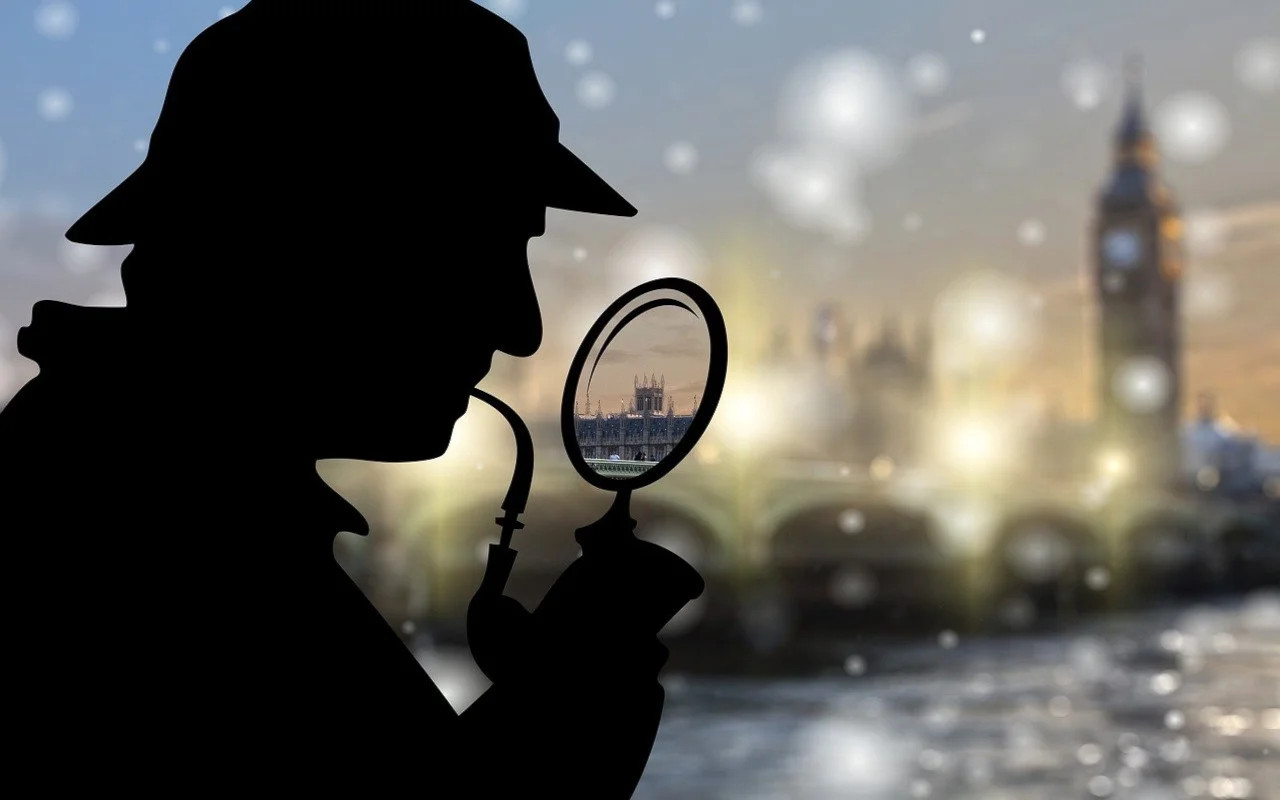
Sherlock’s Accessories, so closely linked to the character—like the pipe and the deerstalker hat—were altered for the theater. In the books, the pipe was long, but in the first stage play, they decided to change it to a curved one so the audience could see the actor’s facial expressions.
The deerstalker hat was created by an illustrator, modeled after one his brother used for hunting. As for the violin, he played a Stradivarius unique in its sound, using it to abstract himself and concentrate on finding the answer.
First Successful Novel. As the story goes, Oscar Wilde invited Doyle to dinner, where they met the editor of Lippincott’s Monthly Magazine, who commissioned a story from each of them. Wilde provided The Picture of Dorian Gray, and Conan Doyle delivered The Sign of the Four (his second novel, and the only one where addiction appears, more as a fleeting diversion during moments of boredom).
The first publications were novels, though serialization was common; he presented them complete.
The Strand Magazine commissioned the first of fifty-six short stories. The magazine’s circulation multiplied, selling over 500,000 copies. A. Conan Doyle eventually came to hate Sherlock Holmes because the character achieved more prominence than he did. He felt he could write much more transcendental texts and decided to kill off the character. He was offered a blank check to name his price to bring the character back to life, and he even suffered threats and assaults in the street.
The Holmesian Canon. This is the set of writings (novels and short story collections) of exclusive authorship by A. Conan Doyle. Most of the texts are narrated by Dr. Watson; only a few are told by Holmes himself or by an omniscient narrator. The Canon consists of four novels: A Study in Scarlet (1887), The Sign of the Four (1890), The Hound of the Baskervilles (1901-1902), The Valley of Fear (1914), and the 56 short stories.
His companion, Doctor John Hamish Watson. He is a doctor with some experience (as was Conan Doyle). Watson had served in the British Army Medical Corps in Afghanistan but was retired after being wounded. However, Doyle gives two different locations for the bullet wound he received while serving—two versions of his injury.
In A Study in Scarlet, he says: «I was struck on the shoulder by a Jezail bullet, which shattered the bone and grazed the subclavian artery.» — Watson speaking of his injury —
However, in The Sign of the Four, he tells us: «…I sat on my chair, nursing my wounded leg. I had a Jezail bullet through it some time before, and, though it did not prevent me from walking, it ached wearily at every change of the weather.»
Some Curious Film Facts.
1903: The first film in which Sherlock appears is a silent movie.
In the 1930s, film adaptations of the books were made. The first successful series (14 films) starred Basil Rathbone (as Holmes) and Nigel Bruce (as Watson). The famous phrase “Elementary, my dear Watson” first appeared in this series, but was never written by the author himself; in the books, only “Elementary” appeared.
The definitive iconography in the popular imagination comes from this series, although the characters are not strictly those from the novels. For example, in the books, Sherlock does not hate the police and works with them, letting them take the credit. In the films, it is the opposite. Watson is portrayed differently (plump) and rather simple-minded—a far cry from how he appears in the books, where he is a friend, companion, accomplice, former soldier, brave, and sharp-witted.
I hope this has been to your liking; I will continue to keep you informed.